
Packaged in a 9 x 12" ziplock
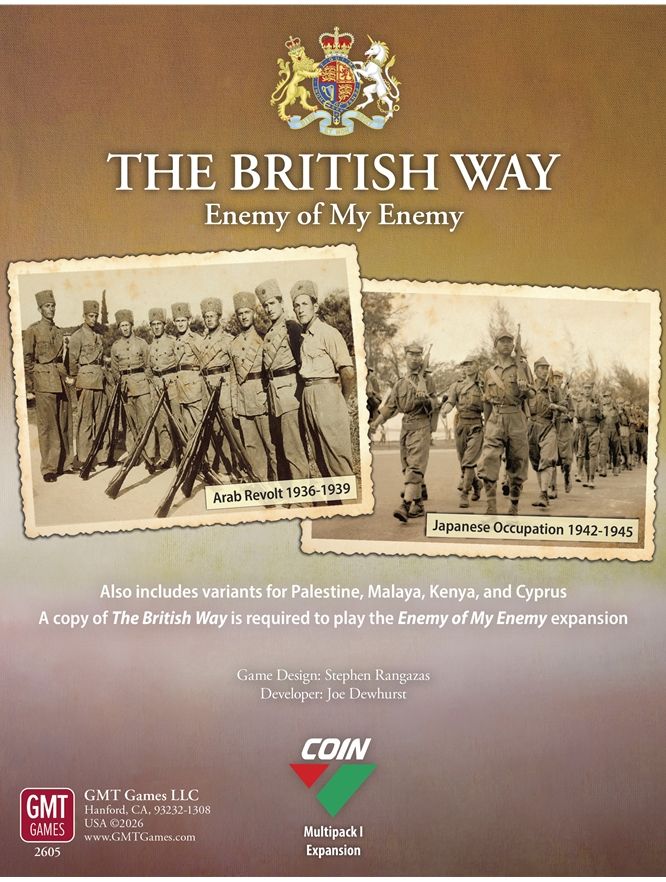
The British Way: Enemy of My Enemy is an expansion for The British Way, including two entirely new games on “prequel” conflicts using the Malaya and Palestine maps and expanding the base game experience with new variants for all four conflicts originally covered. The British Way: Japanese Occupation puts the British and the Malayan Communist Party (MCP) on the same side in their efforts to resist the Japanese occupation of Malaya during World War II. The British Way: Arab Revolt allows players to explore the brutal suppression of the Arab Revolt (1936-1939) that preceded the Jewish insurgency covered by the original Palestine game. The two new games involve entirely new mechanics to capture the unique features of each conflict and can each be linked to the original Palestine and Malaya games, which also allows them to feed into the “End of Empire” Campaign Scenario. The two new games in the expansion allow players to explore how British attempts to combat earlier threats to colonial rule involved collaborating with local armed groups that they would later end up fighting against (Jewish paramilitary groups in Palestine and the MCP in Malaya), ironically strengthening and preparing these groups for two of the conflicts featured in the The British Way.
Arab Revolt
The British Army’s crushing of the Palestinians was of greatest benefits to the Jews. Not only did the Army scatter rebel bands but it left the rural populace impoverished by the counter-insurgency and without the strength for another round of fighting in 1948.
- Historian Matthew Hughes on the 1936-1939 Arab Revolt
The British Way: Arab Revolt utilizes the Palestine map to model the Palestinian Arab revolt (1936-1939) that preceded the Jewish insurgency (1945-1947) covered in the base game. I’ve always considered the Arab Revolt an essential addition for understanding the conflicts covered in The British Way for two reasons. First, the British refined the coercive population control measures later seen in Malaya and Kenya during this conflict, particularly during the last stages where the British forces escalated violence against the civilian population to bring a rapid end to the revolt and free up troops for the looming war in Europe. Second, several players have noticed an absence of Palestinian representation in The British Way: Palestine. As reflected in the quote above, severe British repression during the 1936-1939 revolt exhausted the Palestinian community, leading Jewish armed groups such as Irgun to view Britain as their primary opponent during the Jewish insurgency era covered by the original Palestine game. After achieving British withdrawal, during the subsequent 1947-1948 conflict Jewish groups also had an advantage over Palestinians due to this same exhaustion. Therefore, the Arab Revolt is crucial for understanding both the evolution of British counterinsurgency and the lasting conflicts in the region that continues to the present day.
Mechanically, the Arab Revolt game focuses more on rural District spaces, rather than the City spaces that are crucial in the Palestine game. In addition, several spaces marked “Out of Play,” such as Syria and Transjordan, become playable in the new game. The Arab Rebels are more akin to the rural insurgents featured in Malaya and Kenya than the clandestine Cell Factions of Irgun and EOKA but suffer from disunity within their movement. The Arab Rebels interact differently with the Initiative Track and are forced to manage a new “Coordination Track.” The British gain access to Irregular pieces representing Jewish Special Night Squads and Arab “peace bands” and new mechanics for collective punishments covering the extensively used punitive fines, house demolitions, and detentions.
Japanese Occupation
These forced resettlements call to mind the new villages created by the British army in the late 1940s and 1950s. There is no direct evidence that the British army used the model provided by the Japanese army. However, Malayan Chinese deported by the British authorities in 1950 wrote that the “subjugation bases” of the British were modelled on the “pacification policy” of the Japanese.
- Historian Hara Fujio on Japanese and British policy in Malaya
The British Way: Japanese Occupation utilizes the Malaya map to model the Japanese occupation of Malaya during World War II (1942-1945) that preceded the Malayan Emergency (1948-1960) covered in the base game. Although this game does not directly fit the The British Way’s central theme of comparatively exploring the coercive side of British counterinsurgency, I wanted to include a game on this topic for several reasons. First, although there are many great wargames on the major conventional campaigns of World War II, including on the fall of Malaya and Singapore, there are far less games focusing on the realities of occupation, particularly for countries outside of Western Europe (Brian Train’s upcoming COIN game, China’s War, being a major exception). By featuring Japanese repression and resource extraction, players will hopefully gain a more diverse view of World War II that shifts attention away from “great battles” and “squabbling generals” to the consequences of the war. In addition, British efforts to support armed opposition to the Japanese occupation through their Force 136 strengthened the Malayan Communist Party (MCP), the most effective resistance group, setting up their post-war confrontation featured in The British Way: Malaya.
Mechanically, The British Way: Japanese Occupation features a new approach to victory conditions compared to other multipack games and new mechanics to cover Japanese counterinsurgency techniques such as the use of Kempeitai secret police units. The Japanese must extract and transport as many resources as possible from Malaya to support the broader war effort while containing the resistance movements. The resistance movements must sever new railway pieces, collect intelligence for Allied forces, and build up their forces to challenge Japanese occupation. If linking into a game of The British Way: Malaya, the British must also consider how much to build up the resistance forces, knowing that those same forces will likely be used to resist British rule after the war.
The four new variants for the original four games featured in The British Way add additional strategic complexity and historical accuracy for those familiar with the base game dynamics. The expansion also includes new versions of a few base game Event cards for each game to ensure the new variant mechanics are fully integrated into the gameplay.
Rockin' B Games is a family owned and operated small business established in the Fall of 2010.
In Cart / Check-out Discounts
Receive the following discount at checkout when your order exceeds:
$50 take 5% off | $75 take 10% off | $100 take 15% off
Discounts are applied automatically. No code required.
Store Policies
Primary topic links can be found at the bottom of this page. A complete policy section can be reviewed at: Policies