
Special Note: On page 11 of the Rulebook, the yellow d12 die shows an “8”. This illustration is incorrect as that side of the die is blank. On page 12 of the Rulebook featuring the “Skill Dice Manifest”, the top right image of the d12 die face features an “8”. This illustration is also incorrect as that side of the die is blank.
From Game Designer Matt Calkins (designer of Sekigahara and Charioteer):
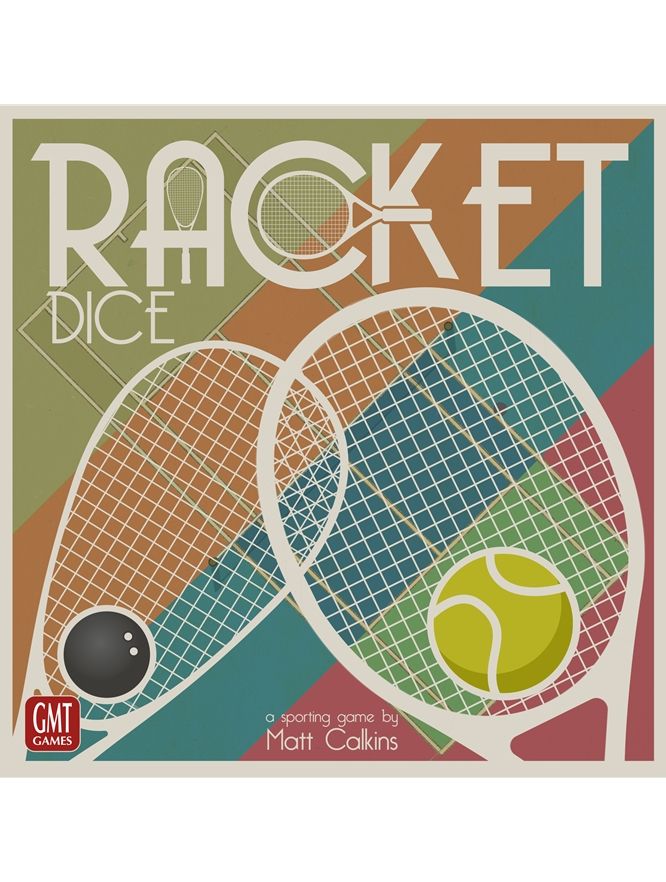
Racket Dice is a two-player bluffing promotable-dice game with a racket sports theme.
I write games I want to play. A couple of years ago, I wanted a short two-player game full of interesting situations and rapid decision-making. Racket Dice is the result of that effort.
You play in a series of hands. The stakes of each hand is determined in a bluffing sequence before the bid starts. After each hand, the winner spends what they must and claims their points, both players recover some lost resources, and a new hand begins.
My favorite thing about the design is the skill dice. Each player has one special die for each of three abilities: hitting, agility, and stamina. The number of sides on the die indicates how good they are in five increments (d4, d6, d8, d10, and d12 is the best). Players start low but upgrade these skills during the game. Upgrades involve sacrifice, requiring players to choose the right moment to advance a skill.
The three skills are unique and lead to different playstyles. A specialist in hitting makes more hand-winning plays. The agility player builds their energy stockpile for later advantage. The stamina specialist wins long points with very high numbers.
(One delight in game-writing: to summon a latent variable to a new purpose. In Sekigahara, I used hand size to depict legitimacy. In Racket Dice, the number of faces on a skill die depicts the degree of skill.)
I love the ‘false bid’ tokens. They allow a player to lie about their dice and win a hand for nothing, so long as they’re not caught in the process.
You can ‘lie’ in Liar’s Dice and not know for sure whether you’re lying. You can ‘bluff’ in Poker without knowing you have the low hand. But a false bid in Racket Dice is objectively false. It’s a test of nerves. It’s great when a game makes your heart race.
This game works because it creates asymmetrical situations. Players build divergent strengths among various commodities on their way to victory: energy, skills, points, etc. Players make decisions that can be rightfully called ‘strategic’ even in the context of a quick dice game.
Racket Dice is two games in one, on either side of the board. Squash Dice is the basic game; Tennis Dice is quicker and has a few extra rules. I recommend starting with squash in order to learn the basics, and using the advanced rules (‘false bid’ tokens) as soon as possible.
-Matt
I grew up playing dice games with my parents and brothers. We brought dice cups on our camping trips and played under portable lamps after the sun went down. In this design I hope to recapture the fun of those old games, but with new emphasis on planning and hard decisions.
I made this game about racket sports because some important people in my life love squash and tennis. But the theme also presented an intriguing challenge, since there are so few games on the topic. I wanted Racket Dice to bring players close enough to a tennis/squash match that every hand felt different. The sports may be structurally repetitive, but from a player’s perspective, each moment is full of unique considerations.
Until now, I’d avoided putting dice in my games, because they add so much randomness. In my first four game designs there’s just one die: the emperor die in Charioteer. Despite all the unpredictability in Racket Dice, there are still interesting decisions. Players trade between three commodities: dice, energy, and score. I like the asymmetrical situations that imbalances between these things can create. I like the way promotions cause temporary sacrifice. I like having to decide when it’s worth spending precious energy.
The most unusual thing about this design is the promotable dice. I love how dice get stronger with every step from d4 to d6, d8, d10, and d12. I’ve been experimenting with this idea for years, and considered it in at least three different designs, but it worked best here.
I love the ‘false bid’ tokens that allow a player to lie about their dice and win hands for nothing -- but only if they’re not discovered. The penalty for being caught in a false bid is severe, so these tokens must be used very carefully. A game that affects your heart rate is a good game.
One bit of advice: don’t get short of energy. It’s useful for so many things; without it you lose a lot of flexibility. And when your opponent lacks energy, it’s time to raise the stakes and bluff.
Rockin' B Games is a family owned and operated small business established in the Fall of 2010.
In Cart / Check-out Discounts
Receive the following discount at checkout when your order exceeds:
$50 take 5% off | $75 take 10% off | $100 take 15% off
Discounts are applied automatically. No code required.
Store Policies
Primary topic links can be found at the bottom of this page. A complete policy section can be reviewed at: Policies