
“The Coastwatchers saved Guadalcanal, and Guadalcanal saved the South Pacific.”
- attributed to Admiral William Halsey
THE HISTORY: The Australian Navy after the Great War developed a volunteer service to watch for unusual ships off the country’s shores. With colonial mandates over New Guinea and the Solomon Islands, “coastwatchers” there formed a warning fence against surprise attack. Each coastwatching station had a heavy but relocatable teleradio, one or two Australians (typically) in command, and a local network of indigenous scouts, spies, sentries, messengers, carriers, and canoe men.
Not originally envisioned as spies behind enemy lines, many coastwatchers found themselves as such when the Japanese invaded the region a few weeks after Pearl Harbor. If caught, they faced execution. Some 30 coastwatchers were taken over the course of the war.
But, through their individual adaptability and daring, the coastwatchers proved to be uncommonly successful field operatives, reporting on Japanese military buildups, rescuing fleeing civilians and castaway naval and air crew, occasionally picking off Japanese patrols and barges, and helping guide amphibious landings and overland marches in the eventual Allied counteroffensive.
“Forty bombers heading yours.” – Coastwatcher transmission to Guadalcanal
Most critical for the South Pacific campaign, the coastwatchers gave Allied forces distant early warning of Japanese air and naval sorties, such as the raids on Henderson Field or the vaunted “Tokyo Express.” Serving in effect as human over-the-horizon radar, the coastwatching network enabled Allied defenses to ready for, meet, and defeat strikes out of Japanese island and coastal bastions. As well, human operatives gave cover for the precious and perishable Allied codebreaking, as the public and the enemy would attribute any hints of Allied foreknowledge to the famed coastwatchers that the Japanese were already hunting.
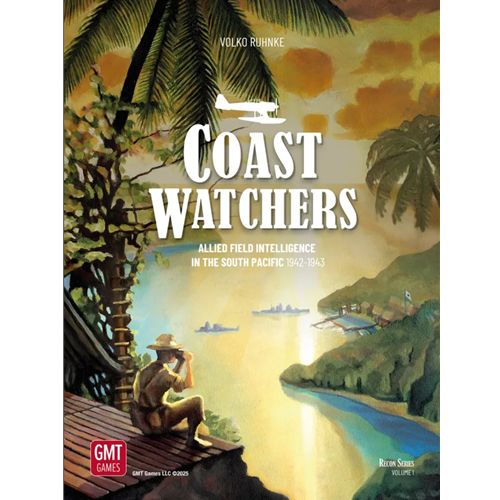
THE GAME: Coast Watchers takes you into this struggle between Allied intelligence teams and Japanese hunters. Standup blocks hide coastwatching stations, guerrillas, refugees, and stranded Allied crew. Gameboard recesses hold the blocks snug. Facedown counters hide the buildup of Japanese forces, which the coastwatchers seek to observe and report to headquarters. Other counters show where Japanese patrols are searching for coastwatchers or go into and get drawn from a cup to run Japanese searches and Allied delivery missions.
Each side has Mission cards. Allied Missions assign side tasks to the coastwatchers. Japanese Missions lay out secret military objectives for victory points, including air and sea operations against which the coastwatchers are to warn Allied forces. By hunting coastwatchers while building up military readiness and guiding operations, the Japanese player seeks to slip through the enemy intelligence net.
Players also draw Asset cards: special abilities to augment actions and perhaps add victory points.
Coast Watchers offers 15 standalone “Situations” plus 4 campaigns to tie them together. The Situations span the early-1942 Japanese incursion into the South Pacific to the neutralization of their great base at Rabaul by the end of 1943.
Rockin' B Games is a family owned and operated small business established in the Fall of 2010.
In Cart / Check-out Discounts
Receive the following discount at checkout when your order exceeds:
$50 take 5% off | $75 take 10% off | $100 take 15% off
Discounts are applied automatically. No code required.
Store Policies
Primary topic links can be found at the bottom of this page. A complete policy section can be reviewed at: Policies